Have you ever wondered how to set SMART goals and objectives? How to achieve your academic ambitions in 2026 without repeating the unbeneficial habits?
Semester II is a critical period for international students with major milestones like final IB projects, high-stakes AP exams, or extracurricular competitions and projects. Naturally, students’ minds usually start racing with countless goals. Students might find themselves thinking: “I want to get better at Math,” “I’ll improve my English,” or “I’ll read more to boost my IB points.”
However, reality often hits hard. Without a specific plan with clear guidance or strategy, motivation fades, and those resolutions are pushed to the next “new beginning” without ever reaching the finish line. Do students resonate with the scenario? Have you ever wondered why the situation keeps repeating? The issue is not your effort – it is your strategy. Goal setting is the first step, but SMART objectives are what ensure you with clearer vision and the road to fulfilling your goals.
In this blog, Everest Education introduces the SMART objective model and how to apply the method to your academic journey in 2026, optimizing study time and achieving breakthrough results. Everest Education also offers personalized solutions for students to strengthen their academic foundation in Math and English Language Arts (Academic English), optimizing their academic achievements in international environments. Designing curricula based on international standards like the US Common Core and the CPA Singapore Math teaching method, Everest Education guarantees to intrigue curiosity and learning passion within students, motivate them to explore the academic world, and optimize their performance at international schools. With 12+ years of experience accompanying 15,000+ students from international schools in Ho Chi Minh City, Everest Education strongly claims ourselves as a trusted partner for families in supporting students to achieve excellent performance at international schools.
According to the goal-setting theory by Edwin Locke and Gary Latham, specific and challenging goals lead to higher performance than vague or easy ones. Instead of saying, “I want to be good at English,” specify it: “I want to achieve a 7.5 IELTS” or “I want to master Academic Writing”. A clear target tells your brain exactly where to focus.
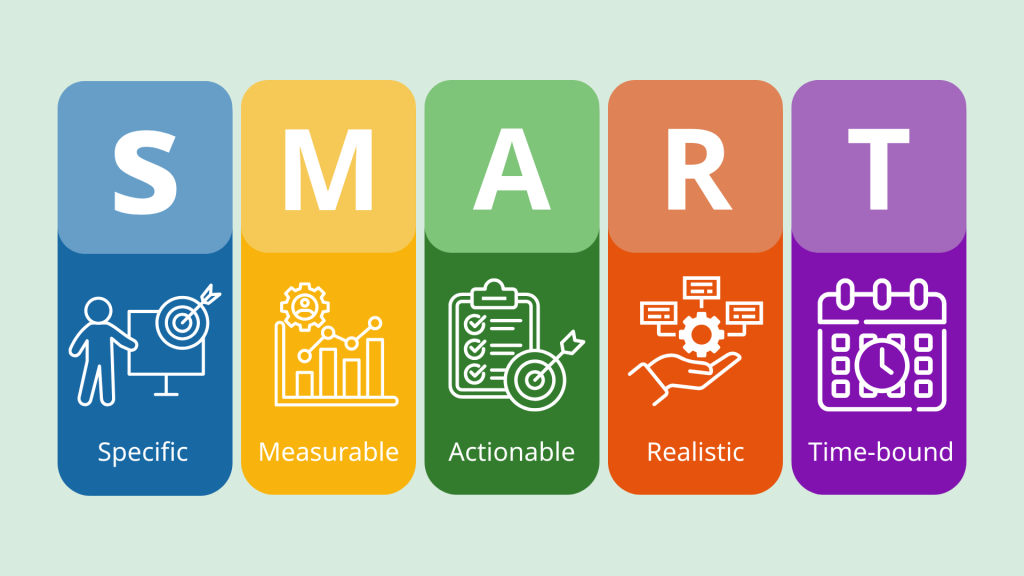
SMART is not just an adjective; it is a methodology developed by George T. Doran in 1981. Originally for strategic business planning, it has since expanded its practice for personal development. SMART stands for five criteria that help students shape a specific goal with clear objectives:
S – Specific: Goals must be clear and well-defined. Define exactly what you want to achieve.
M – Measurable: Attach numbers or quantifiable outcomes to track progress.
A – Actionable: Do not stop at the “what” – define the “how” with specific actions and time spans.
R – Realistic: Goals should align with your current abilities, available time, and long-term academic strategy.
T – Time-bound: Every plan needs a “deadline” to prevent procrastination.
2. How to Apply the SMART Objective Method to Achieve Your Academic Goals
To make your academic targets achievable, let’s look at how to apply SMART criteria to common international school challenges:
Actionable: Spend at least 45 minutes every evening practicing past paper questions.
Realistic: Moving from a 4/7 to a 6/7 (Aiming for a 4-point jump from 3 to 7 in one semester may be too ambitious and lead to burnout).
Time-bound: By the final exams in May 2026.
=> The SMART Goal: “I will raise my IB Math score from 4/7 to 6/7 by practicing past papers for 45 minutes every night to prepare for the finals in May 2026.”
Specific: Master English Reading Comprehension skill.
Measurable: Complete 5 non-fiction English books.
Actionable: Read for 30 minutes every morning.
Realistic: Choose books related to your favorite topics (e.g., Science, Chemistry) to stay motivated.
Time-bound: Before June 2026.
=> The SMART Goal: “I will complete 5 English books on Science by reading for 30 minutes every morning to master my Reading Comprehension skills by June 2026.”
3. Everest Education: Your Trusted Partner in Achieving Excellent Academic Goals in 2026
Setting “SMART” goals is one thing; staying the course is another. A common pitfall of the SMART goals method is focusing more on quantity than quality. You might commit to “45 minutes of Math,” but how do you evaluate your progress or identify specific gaps in your logic without professional guidance?
The academic journey in 2026 is much smoother with expert guidance. At Everest Education, we support students in Semester II and beyond with a team of teachers who have helped over 10,000 students navigate IB, SAT, IGCSE, and AP exams. We build personalized learning plans tailored to each student’s specific goals and unique learning styles, whether in small groups or 1-on-1 tutoring, with regular updating of progress to ensure your child stays on track. On average, E2 students experience a 1-2 point increase per IB subject after just three months.
Furthermore, E2 believes Math and English Language Arts are the two academic foundations for success at international schools. Math trains logical analysis, while English Language Arts (Academic English) provides the literacy tools to articulate complex ideas across all subjects.
With curricula based on US Common Core standards and the CPA (Concrete-Pictorial-Abstract) Singapore Math method, Everest Education is a trusted partner that accompanies families in students’ academic journey at international schools.
Success in a new year requires more than just well-wishing, but SMART objectives and strategy. By making your goals Specific, Measurable, Actionable, Realistic, and Time-bound, you turn “dreams” into “reality”. Let Everest Education accompany parents and students in conquering academic challenges in international environments.