Students at international schools need to consider different international programs like IB Diploma Programme, Advanced Placement (AP), or A-Level. The late middle school to early high school period is a crucial transitioning stage for students, especially international students. This is the time when parents and students need to carefully consider a suitable high school program and prepare an effective academic path, putting the first brick on the child’s journey to university.
Amongst IB, AP, and A-Level, IB Diploma Programme, or more commonly known as International Baccalaureate (IB), stands out and are widely taught at more than 10 international schools in Ho Chi Minh City like Australian International School (AIS), British International School (BIS), International School Ho Chi Minh City (ISHCMC), and Saigon South International School (SSIS).
In this blog, Everest Education will comprehensively explain about the International Baccalaureate Diploma Program (IBDP) and three reasons why parents should choose IB Diploma Programme for their children’s high school path:
Globally recognition – IB certificate as an “academic passport” that opens doors to many universities in Vietnam and around the world
Comprehensive academic foundation of knowledge and skillset at university level
Clear professional direction for the university journey in the future
In addition to choosing an appropriate international program, equipping students early with a solid academic foundation of knowledge and skills is as much important. Everest Education can accompany students on that journey with Singapore Math and English Language Arts course. Our Math curricula apply Singapore-recognized CPA (Concrete – Pictorial – Abstract) methodology while English Language Arts courses are developed based on US Common Core Standards. Everest Education also offers Test preparation courses and 1-1 Tutoring programs for varied international programs and tests including IB, AP, A-Level, SAT, etc. Everest Education will design personalized strategic study plan that is tailored to each student’s abilities, learning style, and needs.
1. Overview of the IB Diploma Programme
The International Baccalaureate Diploma Programme (IBDP or IB Diploma Programme) is an international high school program for students aged 16-19 founded by the International Baccalaureate Organization (Switzerland). The IBDP lasts 2 years with 6 subjects assessed on a 7-point scale and 3 DP cores.
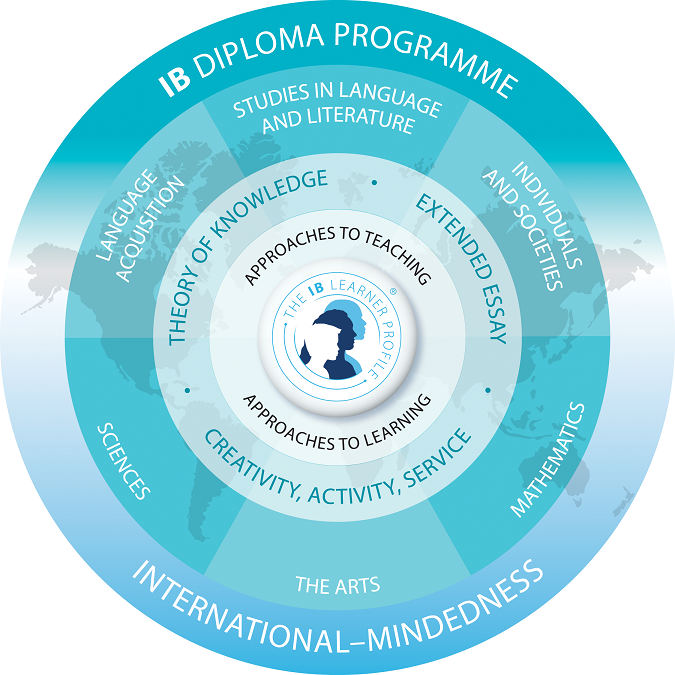
6 subject groups and 3 DP cores of IB Diploma Programme
Throughout the 2-year program, each IBDP student must choose 6 subjects from 6 groups (Language and Literature, Language Acquisition, Individuals and Societies, Sciences, Mathematics, and the Arts). Students are required to take 3-4 High Level subjects (240 hours) and 3 Standard Level subjects (150 hours).
Students can develop soft skills, creative thinking, and cultivate their character and social awareness through 3 DP core courses: Theory of Knowledge (TOK), Creativity, Activity, Service (CAS), and the Extended Essay (EE).
Specifically, the Theory of Knowledge (TOK) delves into the nature of knowledge and explore “how we know what we claim to know”. This DP core requires students to complete 1 TOK exhibition and 1 essay of 1,600 words.
For the Creativity, Activity, Service (CAS), students must take initiative in experiences and independently establish an extracurricular project that includes one of three elements:
Creativity: activities involving artistic experiences and creative innovation
Activity: activities that promote physical development
Service: volunteer activities, community service that make meaningful contributions to society
The remaining Extended Essay (EE) requires students to complete 1 research paper of 4,000 words at university level.
To graduate from the IB Diploma Programme (IBDP), students must achieve a minimum of 24 out of 45 points and successfully complete the three core components. Unlike international programs such as AP or A-Level, the IBDP does not rely solely on end-of-course exams. Instead, it utilizes various assessment formats throughout the program, divided into two main categories:
Internal Assessment (IA) (70%): includes presentations, scientific experiments, artistic performances, etc. These are graded by school teachers and later moderated by the IB Organization to ensure authenticity and standards.
External Assessment (EA) (30%): conducted at the end of the program. These assessments feature diverse formats such as essays, case studies, and short-answer questions.
These varied assessment methods require students to develop flexible thinking, self-discipline, and a strong sense of responsibility for their own learning. Most importantly, students need to establish a strategic plan early on to avoid burnout or becoming overwhelmed during the final period.
2. Three Reasons Why Students Should Pursue the IB Diploma
a. Global recognition – an “academic passport” to top universities in Vietnam and worldwide
The IBDP with university-level syllabus is a pathway that prepares students comprehensively for the rigors of higher education. According to the International Baccalaureate Organization, the rate of IB students accepted into top 20 universities is three times higher than that of A-Level students.
The IBDP is taught at over 3,000 schools worldwide. In Ho Chi Minh City, prominent international schools offering the IBDP include the Australian International School (AIS), British International School (BIS), International School Ho Chi Minh City (ISHCMC), and Saigon South International School (SSIS).
The International Baccalaureate Diploma can be considered an “academic passport”, granting students access to leading universities globally, with recognition from over 4,500 universities across more than 110 countries and territories. Notable examples include Ivy League institutions in the U.S. (such as Harvard and Princeton), top-tier UK universities (like Cambridge and Oxford), and prestigious Asian and European institutions such as the National University of Singapore (NUS) and Nanyang Technological University (NTU). In Vietnam, IBDP is recognized by institutions including RMIT University, Swinburne University, Ho Chi Minh City University of Technology, International University, and the Faculty of Medicine – Vietnam National University.
b. Comprehensive academic foundation of knowledge and skillset at university level
The global prestige of IBDP lies in its curriculum structure, which equips students with a holistic foundation of knowledge and academic skills. Beyond learning abstract theories, IB students are trained in critical thinking, interdisciplinary knowledge correlation, and advanced research and analytical skills.
Instead of passive reading and note-taking, IB students are motivated to dive deep into the core of every subject. For essays and research projects, students must synthesize a wide range of academic sources including peer-reviewed journals typically used at higher education levels. They learn to distinguish credible sources and maintain a critical mindset to synthesize and analyze information into their own original work. This process demands an early start, meticulous planning, multiple drafts, and revisions before finalizing their works.
Managing six subjects alongside the three DP cores simultaneously requires IB students to demonstrate high levels of autonomy, discipline, and resilience. Most importantly, they must master time management and strategic planning to avoid overwhelm and stress when multiple assessments and projects converge.
c. Clear professional direction for the university journey in the future
The IBDP requires students to select specialized subjects early on that correspond to university majors, such as Psychology, Business Management, and Economics. This provides IB students with the opportunity to explore and engage with academic fields at a university level ahead of time. As a result, students can discover their strengths and weaknesses across diverse disciplines, enabling them to choose the most suitable university major and proactively build a strategic profile for their future college applications.
With its global recognition and comprehensive curriculum, the IBDP is a premier choice for high school students worldwide. It serves as a vital stepping stone, cultivating a solid academic foundation and a versatile skill set that opens doors to a bright and promising future.
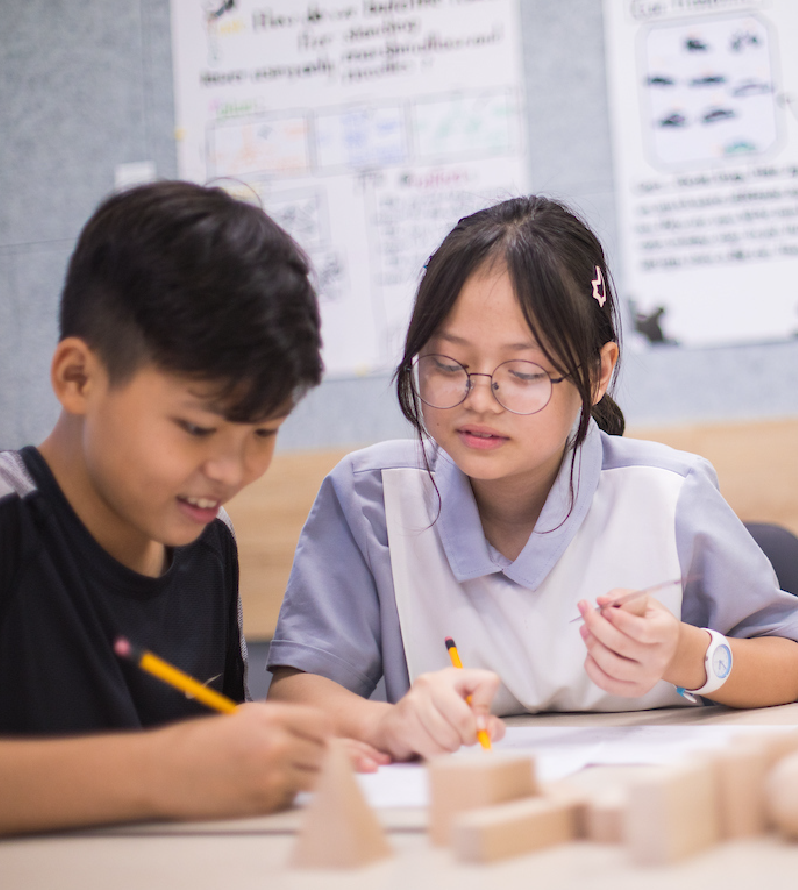
A Math class at Everest Education
3. Everest Education: Your Trusted Partner In Supporting Students With Personalized Roadmap
The International Baccalaureate Diploma Programme (IBDP) is defined by its rigorous academic standards, requiring parents and students to establish a strategic roadmap early on. A common misconception is that the “peak” period only occurs in the final year (grade 12). In reality, many IBDP students, even those long-accustomed to international environments, find themselves in a constant “sprint” and feel overwhelmed from the very first year if they lack proper preparation.
Consequently, families aiming for the IBDP should seek external expert guidance to equip students with a robust academic foundation, a versatile skillset, and the mental resilience required. According to academic experts at Everest Education, the optimal window to begin building this foundation for prospective IB students is between grade 8 and grade 10.
Everest Education (E2) supports parents and students throughout this preparation journey with personalized roadmaps tailored to each student’s unique abilities. Our international tutoring and exam preparation courses do more than just reinforce a solid academic foundation; they ignite a passion for learning and unlock each student’s full potential. Furthermore, E2 teachers provide long-term strategic planning to ensure students avoid the “final sprint” exhaustion during peak assessment periods.
For over 13 years, Everest Education has empowered more than 12,000 international school students, including those in the IBDP. On average, after just three months at E2, IBDP students see an improvement of 1–2 points in their predicted scores or school assessments.
A standout success story is Nhat Ha, a student at the European International School (EIS) in Ho Chi Minh City. In grade 6, Nhat Ha struggled with a dislike for Mathematics and saw no need for outside support. However, after three months of studying with Mr. Max at E2, Ha’s perspective was transformed by Max’s engaging and practical teaching methods. She grew to love the subject and stayed with E2 until grade 12. This long-term commitment culminated in Nhat Ha achieving an impressive 37/45 total points in her IBDP graduation, including a perfect 7/7 in IB Mathematics – a truly remarkable achievement!
The transition from middle school to high school in international systems can be a confusing period for families as they navigate various curriculum options. At Everest Education, we believe the International Baccalaureate Diploma Programme (IBDP) is an optimal choice due to its global recognition and the comprehensive foundation of knowledge and skills it provides – essential baggage for any student’s future university path. However, this does not mean that other international programs are not excellent options. The most critical factor remains a robust preparation strategy.
To best support this academic journey, Everest Education offers strategic solutions with personalized roadmaps tailored to each student’s needs. Additionally, E2 provides Singapore Math and English Language Arts courses with international-standard curricula, helping students build the core academic mindset and skills necessary to excel in international school environments.
Everest Education wishes parents and students success in choosing the appropriate international program and building the essential foundation for a solid academic future.